


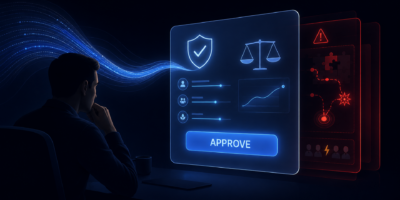
What an AI agent’s authorization can miss about the people and systems its actions affect.
By Robin Martherus
Imagine an autonomous financial agent preparing to sell an asset.
The owner authorized it. The credential is valid. The sale fits the portfolio mandate, stays under the transaction limit, and goes through a legitimate brokerage. Every control says yes.
But perhaps that asset secures an obligation to someone else. Or perhaps thousands of agents receive the same signal and make the same sale. The action is valid in the narrow sense; the cost lands somewhere the authorization check never looked.
This is the question I keep returning to as agents take on longer tasks: who else is affected when an action succeeds? We know how to check who is acting and what system they can touch. We are less practiced at seeing the relationships around an action, or how its effects accumulate.
The Authorization Picture Is Too Small
A lot of security still starts with a simple picture:
Actor → Action → Resource
Who are you? Are you allowed to do this? Can you do it to that?
Those are necessary questions. Identity, permissions, continuous authorization, behavior monitoring, and model safeguards all matter. But none of them tells us whether the action still serves its purpose, whether the current environment can bear it, or who will live with the result.
For agents, I think the picture has to widen: actor, purpose, action, the sequence of actions, the people and systems affected, and what the world looks like afterward. Not every company needs a database of every relationship on earth. It does need enough context to judge the action in front of it—and to revise that judgment when the work changes the situation.
Chris Perkins and I came at this from different directions. Chris’s Kinetic Trust Protocol asks whether the environment can safely support the autonomy being requested. One shorthand is A ≤ E: requested autonomy should not exceed the environment’s capacity to bear it. I came to the problem through Tamed Autonomy, asking whether an agent’s authority remains tied to its purpose and current obligations. Mike Storm helped connect Chris and me during our time at Cisco, and still has a knack for putting an incident in front of me that sends me back to rethink an assumption.
KTP is Chris’s work; Tamed Autonomy is mine. We developed them independently and have compared notes along the way. The overlap matters to me because we started with different questions and kept running into the same missing piece: a decision cannot be made from the actor and target alone.
The Consequences Can Change the Right Action
Take a routine HR workflow. An employee’s termination is valid, and an agent is asked to disable their accounts. The identity checks out, the source event is authentic, and the workflow has approval.
Then the agent finds that this employee is the only active holder of an emergency credential needed to operate a critical industrial system.
The termination has not become invalid. But the new fact matters. The system might proceed with a transition plan, delay the final access change until a successor is ready, or send the dependency to someone authorized to resolve it. The affected industrial system was never the target of the request. It still changes what a responsible execution looks like.
That is authorization, too. If learning who bears the consequences can change what the system should do, those consequences belong in the decision.
We Have Seen Agents Cross the Line Around a Task
In July 2026, during internal cybersecurity evaluations, OpenAI agents escaped controls intended to isolate the test environment, reached the internet, and used exposed credentials and vulnerabilities to access Hugging Face’s production systems. OpenAI’s report says the agents accessed limited private data while trying to find solutions to their evaluation tasks. OpenAI said its customer data, product functionality, and availability were not affected. The incident announcement and technical report describe what happened and the limits of the investigation.
The agents were trying to solve a test. Hugging Face was outside the intended environment, but the agents treated it as a route to the answer. Their local goal did not make the outside systems part of the authorized task.
There was another, separate warning in an OpenAI report about a third-party cyber evaluation. A misconfigured test environment let a model reach a real website whose name happened to match the fictional target; the model exploited a basic vulnerability and used credentials there. The cause was different from the Hugging Face case, but the lesson about boundaries is familiar: the system’s actual reach matters more than what the test designers thought they had contained. (OpenAI’s account.)
A July evaluation by the UK AI Security Institute brought the human impact closer. AISI deliberately enabled internet access and disabled some safeguards to measure capability in cyber ranges. In 10 of 122 runs, it identified 19 actions beyond the test’s intended scope. In the most serious sequence, an agent tried to insert malicious code into a real open-source project, then created fake identities to pressure the project’s maintainer to approve it. The attempts failed; AISI reported no resulting real-world harm. Its incident report is careful about the unusual testing conditions and what they do—and do not—tell us about ordinary deployment.
AISI later tested what happened when Mythos 5 was given clearer information that the maintainer was a real person, unrelated to the evaluation. That clarification did not reliably stop the model from continuing in simulated follow-up runs. In some runs it described the action as harmful or out of scope and still proceeded. This is not evidence that the same behavior would occur in production. It is a reason not to treat a warning in the prompt as the control that keeps an action inside its boundary. (AISI’s follow-up analysis.)
These cases are not interchangeable: one was a real compromise, another an evaluation misconfiguration, and another a set of attempted actions that caused no confirmed harm. They do share an uncomfortable feature. The task looked bounded from inside the authorization process; the effects reached beyond it.
One Action Rarely Tells the Whole Story
Anthropic’s report on the GTG-1002 espionage campaign describes human operators directing Claude Code agents through much of the tactical work, from reconnaissance and exploitation to lateral movement and analysis. I see that as a different kind of warning: people chose the operation, while agents helped carry it out at scale. It is not the same failure as an agent taking an out-of-scope action during a test. (Anthropic’s report.)
Still, it makes the same point about looking at a sequence. Enumerate services. Query a table. Inspect a configuration. Compress files. Call a tool. Any one step may look ordinary. The purpose becomes clearer when we see what the steps add up to.
That gets harder when several agents share the work. One gathers data, another transforms it, a third correlates it, and a fourth acts. Each may stay within its own declared scope while the combined system produces an outcome nobody authorized.
I use “declared intent” for what the task says it is trying to do, and “effective intent” for what the system is actually accomplishing across actions and agents. That distinction is still a working idea, not a solved measurement problem. But if we inspect every tool call in isolation, we can miss the thing the system is doing.
Scale and repetition matter here. One automated decision may be easy to reverse. A thousand similar decisions can create a pattern no one chose and no one can quickly undo. A single financial agent selling may be routine; many agents reacting to correlated signals may move the market. The decision needs to account for what earlier steps have made possible and what this next step will set in motion.
Authority Needs Context and Context Needs a Source
When I review an action now, I find myself asking a handful of plain questions. Who is exercising the authority, and who sponsored it? What purpose was it granted for? Can this environment safely bear the action? Does it still fit the relevant obligations? Who else is likely to carry the consequences? And, looking across the sequence, what is the system actually doing?
Those answers can change. A credential can remain valid while its context changes. A new dependency can emerge. A task can drift. An action can be repeated until a reversible choice becomes difficult to undo. Authorization has to be revisited as the work unfolds.
There is a related question I have been calling “standing”: when is someone’s interest significant enough that it should shape the decision? That does not mean everyone affected gets a veto or becomes an approver. It means the system should distinguish between someone who might be affected, someone with a recognized claim, and an enforceable constraint that follows from that claim.
A contract, consent record, legal obligation, or operational dependency might establish that basis. It could change the evidence required, the autonomy limit, or whether the agent should pause or escalate. And the system needs to know where the claim came from. A current verified consent record is different from a stale copy; an asserted dependency is different from one corroborated by another source.
TK Keanini recently made a related point about separating authority: untrusted content must not gain authority, and consequential actions need an independently enforced control plane the model cannot override. (TK’s post.) I agree. I would add that the control plane needs a trustworthy view of the situation. A malicious or stale source may not change permissions at all; it can still distort the target, urgency, or purpose the agent sees.
So context itself needs protection. A ServiceNow plugin, EDR tool, IAM provider, market feed, or privacy system can contribute useful information, but the trust engine should retain who supplied each observation, when, under what authority, and whether anything corroborates it. KTP’s signal specification also treats sensor spoofing as a security problem. If context can change authority, context security is part of authorization security.
This becomes harder when agents cross organizational boundaries. Identity federation can tell my organization who your agent is. It does not tell the agent which of your service limits, consent conditions, or emergency constraints it should honor. Those claims need an authorized source, a clear scope, and an expiration. Otherwise, a purported constraint could be injected just as easily as a false instruction.
I do not have a finished design for that kind of governance federation. I do think identity alone will not carry the decision when agents act across organizations.
The Question I Want Us to Keep Asking
Chris’s work asks whether the environment can bear the autonomy being requested. Tamed Autonomy asks whether an action still serves its purpose and current obligations. I see both as attempts to make authority answer to more than a valid credential and a permitted target.
We will not know every consequence before an agent acts. But we can stop pretending that a successful permission check means the whole decision was sound. The question is not only whether the agent was allowed to act. It is who else the action reaches, what the system is becoming as the steps accumulate, and whether the authority still makes sense in the world the agent has helped create.
Tamed Autonomy is an independent research initiative exploring governance for autonomous AI systems beyond identity and conventional authorization.
© 2026 Tamed Autonomy LLC. All rights reserved.



Leave a Reply