
By Robin Martherus
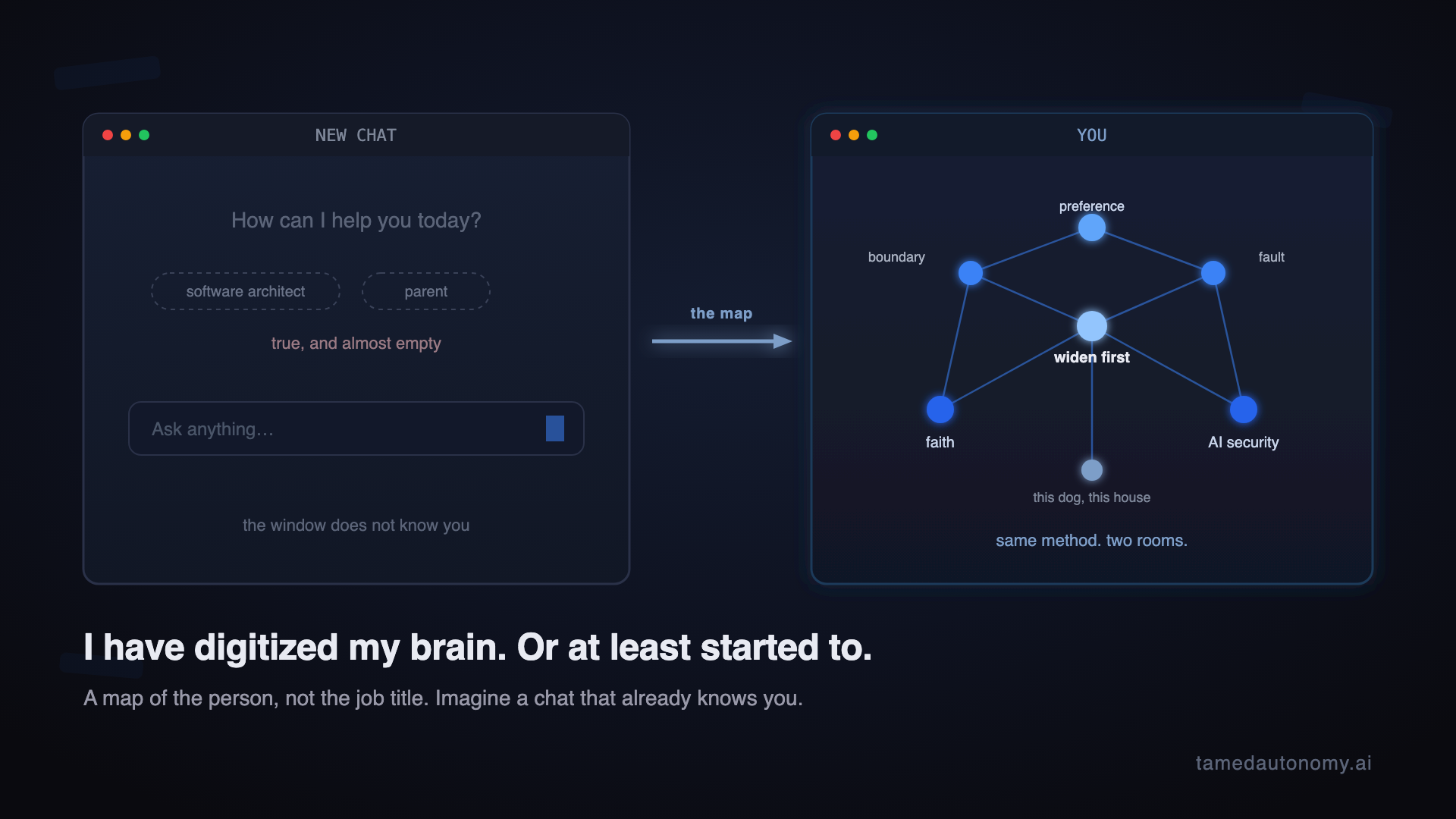
You start a new chat with an AI. ChatGPT, Claude, a coding assistant — it does not matter which. The window is empty. The model is capable. It does not know you.
It does not know how much you already understand. It does not know what you like, what you avoid, where you are strong, where you reliably make a mess. It does not know which work you would rather keep, and which work is just noise you want gone. It does not know which lines you will not cross. So it answers a generic person. You are not one. You can paste a short bio. “I am a software architect.” “I am a parent.” You will still be explaining yourself by the third message. Those labels are true, and they are almost empty. They do not say how you think, what you will not do, where you are strong, where you make a mess, which work you want to keep, which work you want gone.
Imagine the other world. You open a new chat and the assistant already knows you. Not the role. You. The particular mind on the other side of the keyboard: preferences, biases, strengths, faults, the lines you will not cross. It becomes a true assistant because it has individual knowledge of who you actually are — the person who exists outside the window, not the two-word summary you typed to get started.
I have digitized my brain. Or at least started to.1
A graph, here, is not a chart on a slide. It is a set of facts about a person, stored as points, with connections between the points. One point might be a preference. Another might be someone I care about, a belief, a bias I keep repeating, a strength, a fault, a way I solve problems, a line I will not cross. A connection is a claim that two of those points belong together: this showed up when I was reading doctrine, and it showed up again when I was looking at AI security, and it is the same person.
I am not uploading a soul. I am not making a clone. I am building a map of the material a mind actually uses: what I reach for, what I refuse, what I am good at, what I am bad at, what I enjoy, what I will do poorly if I am tired or proud or in a hurry, and where I stop.
In the rest of life, that material is simply who I am. Friends already know some of it. I know some of it and miss some of it. In a chat, the same material can customize the session. An AI that has the map can stop treating me like a stranger. It can also stop treating every task as the same kind of help.
If the map knows where I am weaker, the assistant should show up there: more structure, more checking, more of the work I tend to drop. If it knows where I am strongest, it should get out of the way. Let me make the decision. Let me take the wheel. Do not “help” by flattening a judgment I am better at than it is. If a task is mundane to me, it should just do it. If a task is one I enjoy and would rather handle myself, it should leave it in my hands. Customization is not only tone and memory. It is division of labor with a particular human.
Over time the map should also find my ethical boundaries. Not a manifesto I typed once. Lines that show up in what I will not do, will not ask for, will not let an assistant do on my behalf — in work, in a note to a neighbor, in how other people’s information gets used. Those lines may be narrower than someone else’s, or wider. They are still mine. A generic model offers what a generic person would accept. An assistant that has watched me across a year of chats should not keep walking me up to a door I have already refused to open, and it should not treat that refusal as a formatting preference.
How I take a problem apart is one layer of that map. So are biases, faults, strengths, tastes, and those boundaries. The good, the bad, and the ugly all belong, because they all change what the next session should do. Here is one layer, walked slowly, because it is easy to see once it is named. I am using my own research, not a hypothetical you.
Two Unrelated Problems, One Way of Working
When I look for solutions, I widen first. I do not close on the local tactic. I did not sit down and decide that. I noticed it after the fact, because the same move showed up in two folders that do not share a shelf.
Faith. I am not asking an AI for a tourist summary of “religion.” I am trying to understand a specific teaching: what it actually says, how it relates to another tradition’s version of the same idea, how it looks in a different civilization or in a stretch of ancient history that a survey course would skip. I will sit with that for a long time. I will not accept the first neat answer. I will not let a single quote, a single story, or a single popular picture close the question. I go get more of the picture. Then I decide what I am willing to pin, and what I am not.
AI security. Completely different folder. I am not asking how to put a lock on one tool so an assistant cannot misuse it. The industry already has that conversation. A lot of products sell that lock. I have spent many sessions on a different question: what still goes wrong when the obvious lock is in place? I will not let the small, local fix close the question. I keep asking what kind of problem this actually is, in full, before I accept a tactic.
Faith is not security. Ancient history is not a software lock. The connection is how I behaved in both rooms. I do not close a hard question on the first local answer. I widen the frame. I compare. I refuse to pretend a fragment is the whole problem.
A careful reader will say: that is just what doing research well means. Everyone who is thorough does that. You did not need a graph to know it.
Fair. Thoroughness is not the discovery. The discovery is that my thoroughness has a particular shape — widen until I can see the class of problem, compare before I pin, refuse the local tactic — and that I used that shape in two rooms I would never have filed together. I remember the topics. I do not automatically remember that the approach was the same. Working memory is small. A life is not. I was not taking notes on myself.
The graph can point at the two rooms and say: you used the same method both times. You may not have seen it.
That pointing is also how a fault shows up. I overbuild. I built access rules and policy for this personal map while the map still had almost nothing in it. The graph stayed empty until I stopped. Completeness before usefulness. I do that when I research a teaching, and I do that when I design a control. It is a strength until it is not. A map that only stored “Robin is thorough” would miss the part that actually changes the next session: I will try to construct the whole frame before I have a thing worth putting in it.
I have a one-year-old Labrador. I do not feed her from a breed article. I watch this dog, in this house, and I decide from that. Same shape, smaller room: do not close on the category. Observe the instance. The assistant should not hand me a pamphlet about Labradors, and it should not hand me a pamphlet about “how people secure AI tools.” Both are the category pretending to be me.
Then a Third Problem Shows Up
Now I open a new chat. The subject is neither faith nor AI security. A note to a neighbor about a tree. A research hole. A pile of work, some of it interesting and some of it not.
An ordinary AI, with no map of me, offers a generic method and a generic division of labor. A template. A tactic. A small fix. It also tries to “help” with the part I wanted to keep, and leaves me the part I find empty. It will be competent. It will also be a stranger.
A map that has watched the first two rooms can name a method I did not name, out loud:
You did not close the doctrine question on one claim, and you did not close the security question on one tactic. I am going to try that here first. I am going to widen this the way you usually widen a problem, and see if that gets us to an answer you will trust.
Then it finds out whether the method holds.
If it holds, I never had to teach the model who I am. The third problem met me where I already work.
If it does not hold, that is not a failure of the map. Some problems should not be widened. A neighbor who needs a short, civil note tonight does not need a research program. If the assistant skips my method and jumps to a foreign one, I will question it. I should. If it uses my method, shows me where it breaks, and only then offers something else, I can accept the something else without feeling erased. The useful sentence is:
I tried it your way first. Here is why that way fails this time. So the different solution is not me ignoring you. It is me discovering the limit of a method you actually have.
The rest of the map works the same way. If I am weaker at follow-through than at invention, carry the follow-through and leave me the invention. If I am strongest at judgment, do not bury that judgment under a pile of generated options. If the work is mundane to me, just do it. If I would rather handle it myself, do not steal it in the name of being helpful. If a shortcut would cross a line I have already shown I will not cross, do not offer it as efficiency. Find another way, or say that the task as asked sits on the other side of that line.
This Takes Many Chats, Not One
A single conversation almost never contains enough of a person.
I have had thousands of conversations with different models. They did not produce thousands of introductions. They produced a body of work. One night on a specific teaching. Another on that tradition’s picture of the afterlife. Another comparing it to a completely different civilization. No one of those threads is “my religion.” The pile is. Over time it becomes an opinion, a method, a set of tastes and limits — not the Wikipedia page the model already had.
The same is true of AI security. Those sessions were not “please explain how to lock a tool.” They kept returning to a gap I think current products leave open. A new chat that does not have that pile will restart at the textbook. It will be competent, and it will offer a way of solving the problem that is not mine.
The rest of a life does the same thing. A child. A neighbor’s tree. The Labrador. Each thread is another look at the same mind: what I will not close early, what I insist on observing, what I enjoy, what I avoid, where I am strong, where I am not, and where I stop.
The model already knows religion, dogs, and AI security in the generic. Generic knowledge is not the issue. The graph is the difference between “here is how people usually handle this” and “here is the person who has been in these chats for a year.”
I do not sit down and fill out a personality form. I talk. The machine may propose a connection: I approached two unrelated problems the same way, or I keep making the same mistake, or I am better at this than I think. That proposal is a hypothesis, not a fact. I confirm it or I reject it. The model does not get to decide, quietly, that it has understood me. If I confirm it, the next ordinary Tuesday should feel the difference.
You Are Not Handing the Model a New Secret. You Are Concentrating Old Ones.
I can guarantee the first question. It will be about privacy. You are giving an AI your personal information.
Fact by fact, the graph is not a new disclosure. It is a structured copy of conversations I have already had with a model. Nothing goes in that a model has not already seen in a chat with me. I am not quietly piping in email, LinkedIn, or a medical portal. If I asked a model to read email or LinkedIn, that was a conversation. That residue is fair game for the map. The graph did not go fetch my life.
That is true, and it is not the whole truth. The premise of the piece is that the map can show me a connection I never noticed. A cross-linked, confirmed picture is more revealing than the loose pile it came from, even if every fact already sat in some thread. Nothing new was typed. Something new was seen. That is a real exposure. It is also the point.
The map stays on my computer. If the next chat is a hosted assistant — ChatGPT in one window, Claude in another — that session may receive a slice. A pattern I built up with one vendor, sent into a chat with another, is new to the second vendor. “Already seen by a model” is not the same as “already seen by this company.” I am asking for a memory on purpose. I should know which door it walks through.
Other people are in the residue. A child. A neighbor. Mail I asked a model to read. They did not sit down and consent to a knowledge graph. “Fair game because I already typed it” is a rule about my secrets, not about theirs. The session should get the slice that would change the answer, not a family history in a note about a tree, and not a doctrine comparison in a question about dog food. Dumping the whole map into a prompt that does not need it is not knowing me. It is oversharing, including of people who are not me.
I do not need an elaborate security system before the map is useful. I built too much of that first — rules about who could see what, before there was much to see. Completeness before usefulness, again. The map stayed empty. I needed the memory before I could govern it.
The Bottom Line
The graph is not for prettier answers in a chat window.
It is a working copy of a mind. Preferences. Biases. Strengths. Faults. Methods I did not know I was repeating. Lines I will not cross, whether they are narrower or wider than someone else’s. In the rest of life, that is who I am. In a chat, it is how a true assistant would already know me — not “software architect,” not “parent,” but the particular person who showed up in a thousand other windows.
Help where I am weaker. Hand me the wheel where I am strongest. Do what is mundane. Leave me what I would rather do myself. Do not walk me through a door I have already refused.
Some of that will make the next session better. The rest was never only for the chat.
1 A follow-up article will be a how-to: how to build this graph for yourself.



Leave a Reply