
By Robin Martherus
On March 11, I published a paper arguing that AI agent governance was heading toward a paradigm shift. I wrote:
Every security paradigm shift I’ve witnessed in thirty years has followed the same pattern: anomaly accumulation, increasingly complex workarounds, conceptual articulation by a few voices, widespread skepticism, a catalytic crisis, then rapid adoption.
The catalytic crisis hasn’t happened yet. But the conditions for one just got concrete.
I thought we had months. Maybe a year. Time to design, prototype, debate, and standardize — the way previous paradigm shifts unfolded over years before the crisis compressed the timeline.
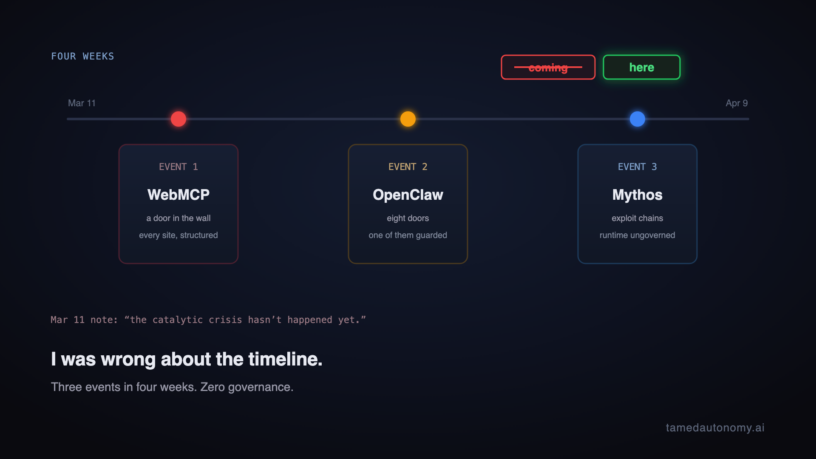
It took four weeks.
Week 1: The Bypass Became a Standard
In February 2026, Google and Microsoft shipped WebMCP — a W3C-standardized protocol that turns every website into a structured agent interface. An agent no longer needs MCP to reach a service. It can interact through the same web interface humans use, with structured data exchange, using the user’s authenticated browser session.
This is not a vulnerability. It is a designed feature, standardized by the W3C, shipped in Chrome 146. And it means every MCP gateway the industry spent the last year building now governs one path while agents have a standardized alternative that bypasses it entirely.
CVE-2026-3918 — remote code execution in WebMCP — landed within a month of launch.
The single-chokepoint assumption underneath the MCP security market became architecturally false overnight. Not because of a hack. Because of a standard.
Week 2: The Most Popular Agent Broke Everything
OpenClaw went viral — 180,000 GitHub stars, two million visitors in a week. Jensen Huang called it “the largest, most successful open-sourced project in the history of humanity.” Finance led enterprise adoption at 25%.
Simultaneously: Meta banned it. Google banned it. Amazon banned it. China ordered state enterprises to remove it. CISOs started scanning endpoints for .openclaw/ directories.
In its first weeks, OpenClaw accumulated a WebSocket hijack vulnerability that let any website silently take over local agents (ClawJacked), a supply chain attack that planted 824 malicious skills in the official marketplace (ClawHavoc), 42,900 instances exposed to the public internet, and Snyk finding 36% of all ClawHub skills contain detectable prompt injection.
The industry’s response was exactly what I predicted: extend the current model. Scan the skills. Sandbox the execution. Register the agents. Monitor the message flows. All necessary. All insufficient. Because OpenClaw has eight access paths and the security products govern a few of them.
Week 4: The Capability Became Superhuman
On April 7, Anthropic announced Claude Mythos — a model that found thousands of zero-day vulnerabilities across every major operating system and web browser. A 27-year-old OpenBSD bug. A 16-year-old FFmpeg flaw that 5 million automated tests missed. Full browser exploit chains. Engineers with no security training obtained remote code execution overnight.
These capabilities were not explicitly trained. They emerged.
Anthropic security researcher Nicholas Carlini: “Today, it is true that language models can autonomously and without fancy scaffolding find and exploit zero-day vulnerabilities in very important pieces of software. This is not something that was true even three or four months ago.”
His assessment of the timeline: “Waiting a year is going to be too long.”
What Changed
Each event alone was significant. Together, they compressed the timeline from “paradigm shift coming” to “paradigm shift here.”
| Event | What It Proved | What Broke |
|---|---|---|
| WebMCP | Agents have standardized paths around every gateway | The single-chokepoint security model |
| OpenClaw | The most capable agent will also be the most deployed — and the least governed | The assumption that enterprise agents will be centrally managed |
| Mythos | Agent capability now exceeds the governance infrastructure designed to constrain it | The assumption that we have time to build governance before capabilities outrun it |
In my original paper, I compared the current moment to previous paradigm shifts: ACLs to identity management (12 years), perimeter to Zero Trust (17 years). I noted that those transitions moved at human speed. I warned that AI agent capabilities were not moving at human speed.
I was right about the direction. I was wrong about the timeline. I expected months of anomaly accumulation before the catalytic event. Instead, three catalytic events arrived in four weeks, each reinforcing the others. WebMCP removed the chokepoint. OpenClaw filled the network with ungoverned agents. Mythos gave those agents superhuman capability. The sequence is not coincidental — it is the exponential that Carlini describes, arriving exactly as fast as he warned.
What the Industry Shipped vs. What It Needed
At RSAC 2026 (March 23-26), the industry shipped its best response: Microsoft Entra Agent ID, Cisco DefenseClaw, Okta for AI Agents, CrowdStrike’s continuous authorization, Palo Alto’s Prisma AIRS 3.0. Impressive products. Real capabilities.
Every one was designed for the threat landscape of January 2026.
By April 7, the threat landscape had changed. The bypass was standardized. The most popular agent was simultaneously deployed and banned. The most capable model was finding zero-days as an emergent behavior. The products shipped at RSAC are Domain 2 answers — securing AI itself — to what is now a Domain 3 problem: governing autonomous agents whose normal operation, at superhuman capability, may cause harm.
The governance primitives I described on March 11 — intent declarations, computed trust, normative constraints — were designed for a world where we had time to build them thoughtfully. That world ended in four weeks. The primitives are still the right answer. The timeline to build them just got a lot shorter.
Where We Are Now
On March 11, I wrote: “The loaded gun is on the table. The question is how long before someone pulls the trigger.”
The gun has been fired. Not once — three times. The breach that forces the industry’s hand is no longer hypothetical. UnitedHealth denied care to patients who couldn’t walk. CrowdStrike crashed 8.5 million systems because automation lacked the judgment to stage a kernel-level update. An AI model can now autonomously construct browser exploit chains that previously required elite human operators.
The question is no longer whether we need governance beyond identity and authorization. The question is whether we build it this quarter or next — and how many incidents accumulate in the gap.
Carlini’s words: “In the long term probably the defenders win. But in the transitionary period between now and then, things probably are very bad. This is why I particularly want people to help immediately.”
We are in the transitionary period. The architecture for the governance layer exists. The policy model for how it should work is defined. The normative primitives that the industry needs are specified. What is missing is the industry cooperation to build them — the same cooperation that built SAML, OAuth, and Zero Trust when previous catalytic crises made the old paradigm untenable.
The difference this time: we don’t have twelve years. We may not have twelve months.
Sources
- I Helped Build the Identity Industry in 1998. I’m Seeing the Same Signals Again. — March 11, 2026
- The Industry Just Built a Wall. Google Put in a Door. — March 19, 2026
- OpenClaw Has Eight Doors. The Industry Is Guarding One. — March 21, 2026
- The Model Can Build Exploit Chains. The Governance Can’t Stop It. — April 8, 2026
- Anthropic Debuts Mythos AI Model — TechCrunch
- CrowdStrike Founding Member of Glasswing — CrowdStrike
- CrowdStrike Global Outage — Wikipedia
- UnitedHealth Algorithm to Deny Care — STAT News


Leave a Reply